Almost every shading guide ever written assumes the enemy is sunlight. In Newlands that assumption is wrong for most of the year. This suburb sits behind the mountain, not in front of it — short of afternoon sun, long on rain, and quietly dealing with damp glass from about May. What a Newlands window mostly needs is to be warm, dry and generous with what light there is. Here is how we go about that, and where the summer still catches you out.
Newlands lies at about 70 metres above sea level, tucked in at the foot of the mountain with Bishopscourt to the south-west, Claremont to the south-east and Rondebosch beyond that; the Liesbeek runs through it and the forest above it forms part of the national park.1 Its reputation is entirely deserved: Newlands is described as the wettest suburb in South Africa, and the reason is a lovely piece of geography working backwards.
The usual rule is that the wet side of a mountain is the side the weather hits first. Here the mountain is not tall enough to stop the winter north-westers, so the saturated air rides up and over the summit and dumps its moisture on the far side coming down — the leeward, eastern side, which is where Newlands is. The result is a suburb that can see up to 2,000 millimetres of rain a year, while Camps Bay, on the supposedly wet windward side, gets under 600.2 The same effect is visible across the whole eastern flank: these slopes take more than four times the rain of the drier western ones.3
Everything else in this guide follows from that one fact. A window specification written for a bright, dry suburb — heavy fabrics, dark colours, blockout as the default — is close to the worst thing you can do to a Newlands room.
Second
Working out when your sun actually goes
Sunset tables are written for a flat horizon. Newlands has a wall of rock in the way. The mountain rises past a thousand metres directly behind the suburb,4 and from a house sitting at 70 metres a couple of kilometres out from the escarpment, that puts the effective skyline somewhere in the region of twenty degrees above the horizontal. That is our own rough arithmetic from published heights rather than a survey — check it against your own wall on a clear afternoon and you will not be far off.
Now set it against the sun. At midwinter the noon sun in Cape Town reaches only about 31 degrees, and it sets on a bearing around 297 degrees, which from Newlands is straight into the mountain; at midsummer noon it stands at roughly 75.5 A sun that peaks at 31 degrees and has to clear a 20-degree skyline does not have long to work with. In June, direct sun is off a Newlands facade a good while before the almanac's sunset — the light does not fade here so much as switch off.
Two hours of real sun on a winter facade is not a shading problem. It is a budget you cannot afford to spend on heavy fabric.
The practical instruction is simple and it changes the whole brief: go and watch one winter afternoon in the room that bothers you. Note the time the direct sun leaves the floor. That single observation tells us more about what to fit than any calculation, and it is the first thing our consultant will ask about.
A half-lowered sunscreen mesh on a Newlands sash in June — enough to take the flare off wet glass, open enough to leave the room its daylight.Third
Why the glass sweats, and what a blind can honestly do about it
Condensation is not a mystery and it is not a fault in your windows. Air holds a certain amount of moisture depending on how warm it is. Cool that air below its dew point and the moisture has to go somewhere, and it goes onto the coldest surface in the room. In a Newlands house through winter, the coldest surface is nearly always the inside face of a single-glazed pane.
That gives three levers, and only one of them is ours:
Put less moisture in the air. Lids on pots, an extractor that vents outside, the tumble dryer ducted properly, wet washing not dried over a radiator in a closed room. Free, and the single biggest lever.
Move the air. A window on the latch for a few minutes twice a day does more than people expect. Sealing a damp house shut makes it damper.
Raise the temperature of the cold surface. This is where a blind earns its place — and only a particular kind of blind does it.
A cellular honeycomb blind is built from cells that trap a layer of still air between the fabric and the glass. Still air is the insulator; the fabric is just what holds it in place. Closed at night in the reveal, it keeps the room's warmth on the room's side and lifts the temperature of the glass's inner face — which is precisely the surface that was condensing. It is the most useful single product we fit in this suburb, and it has nothing to do with sun control.
What we'd fit
Cellular honeycomb blinds in the bedrooms and any room that runs cold — the south-facing ones and the ones under the deepest tree shade first. A double-cell fabric traps more air than a single. Where the room needs privacy at pavement level but light at the top, the same product can be made top-down/bottom-up so you open the head and keep the foot closed.
The catch: a cellular blind does not tilt, so it manages heat and light but not view, and it will not survive being scrubbed. And no blind cures rising damp or a leaking gutter. If the wall itself is wet, that is a building repair and we will tell you so rather than sell you fabric to hide it.
The cells seen side-on against rain-beaded Newlands glass — that trapped air is the whole product; the fabric only holds it there.Fourth
Don't over-specify the dark
The commonest mistake we are called in to correct in Newlands is a house dressed as though it were in a dry, glaring suburb. Deep charcoal blockout in every room, wall to wall, in a house that already loses the sun by mid-afternoon in June and sits under an oak canopy besides. The rooms end up gloomy for eight months to solve a problem that exists for two.
Our working rule here is to spend the light carefully:
Living rooms, kitchens, studies: light-coloured sunscreen mesh, not blockout. A pale mesh at around 5% openness bounces some light back into the room while cutting glare off wet glass, which is a specific Newlands nuisance — after rain, low sun on a wet pane throws a hard flare that a curtain will not fix.
Bedrooms: blockout, yes — but pale, and understand that darkness is a fitting question, not a fabric one. Every blockout fabric is opaque. What wakes you at half past five is the light coming in around the edges. Fitted inside the reveal it looks correct and leaks a hairline; fitted over the opening it is much darker and covers the joinery.
Rooms that want both: a day and night banded roller, or a double roller carrying mesh in front and blockout behind on one bracket. One window, two answers, one set of brackets.
And keep colours light on the room side. In a suburb this shaded, a pale fabric doing 80% of the job beats a dark one doing 100% of it and taking the room with it.
Fifth
The four months that flip it
From roughly November to February, everything above inverts. The noon sun climbs to about 75 degrees, it sets on a bearing of 240 — south of due west, so late glare lands on south-west glass rather than true west5 — and the south-easter starts. That wind blows most consistently from October to March, is funnelled and accelerated by the peninsula's terrain, and is at its strongest in the afternoon once the land has heated up.6
Newlands homes with a north or west elevation that clears the tree line, or a newer glazed addition on the back, get a short, sharp summer heat problem — and on that elevation an interior blind is the wrong instrument. The reason is physical rather than commercial: a blind behind the glass can only intercept energy that has already entered the room, so the pane and the fabric warm up and radiate it back. Intercept it outside and the glass never warms in the first place.
The premium answer, and it belongs outside
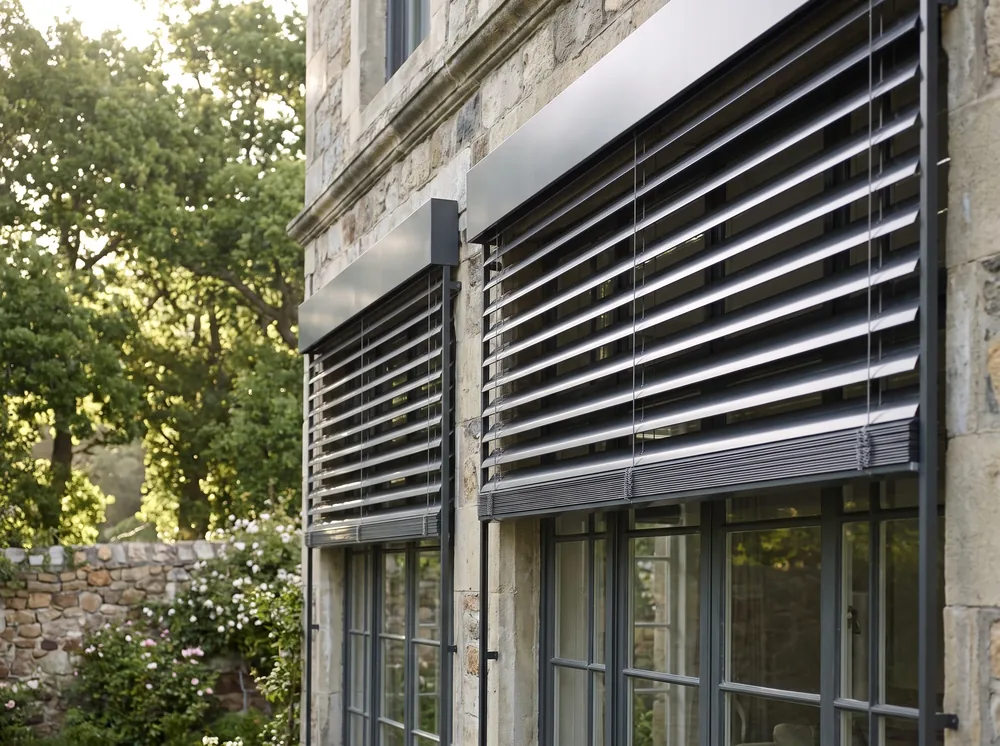
External venetian blinds are the first choice: aluminium slats mounted outside the pane that tilt as well as raise, so the beam is deflected while the view down the valley stays. On a Newlands house they have a second, seasonal virtue — raised entirely in winter, they take nothing away from a facade that needs every hour of sun it can get.
Roller shutters where the room wants more: rigid slats closing down over the glass, shading in summer and adding an insulating air gap in winter, and useful against traffic noise as well. To be plain about it, these are shading shutters for sun, heat and glare — not security-rated products, which are a separate item we can quote on request.
Zip screens for the veranda or stoep. The mesh runs under tension in side channels, so it holds in a gust that would fold an awning arm, and it turns a covered stoep into a usable room on a blustery afternoon.
The catch: all three are fixed to the outside of the building, which costs more and raises the permission question below. Where an external fixing is not possible, a sunscreen roller inside the glass is the honest second-best — cheaper, and clearly weaker on heat.
External venetians on a Newlands stone facade — down for the four hot months, raised right out of the way for the eight that are not.Sixth
Rain, timber and things that rot
Two thousand millimetres of rain is unkind to the wrong material. Three specific cautions we would give anyone furnishing windows in this suburb:
Timber slats belong in dry rooms
Real timber venetians are the handsomest thing on an old Newlands sash, and they are entirely wrong for a bathroom, a scullery or a kitchen window above a sink. Damp gets into the slat, the slat bows, the ladder tapes mark, and no amount of care undoes it. Aluminium in those rooms, every time — it wipes down and does not care.
Fabric near a permanently cold pane wants air behind it
Mould grows where moisture sits still on a cool surface. A blind pressed hard against a habitually wet pane, in a room nobody airs, will eventually show it. Choose a washable fabric in the worst rooms, leave the reveal a little breathing room, and lift the blind on dry days. It is unglamorous advice, and it is worth more than an expensive fabric.
Outdoor shade has to close as well as open
Retractable is not a luxury here, it is the point. A folding-arm awning over a stoep that winds fully into a closed cassette keeps the fabric dry between storms and out of the wind; one left permanently out in a Newlands winter is one you will be replacing. Add a wind sensor and it retracts itself before a gust arrives rather than after the damage.
Cassette shut, fabric dry, mist on the slope behind — how outdoor shade should spend a Newlands winter.Seventh
Older houses and outside fixings
Plenty of Newlands houses are well past sixty years old, and that is a legal fact rather than a decorative one. Under the National Heritage Resources Act, no one may alter or demolish a structure — or any part of one — older than 60 years without a permit from the provincial heritage resources authority, which here is Heritage Western Cape.7
The line is easy to keep straight. A blind inside the reveal is a furnishing decision and touches nothing. A headbox, a guide channel, an awning cassette or a screen track bolted to the outside wall alters part of a structure, and on an older house that needs asking about first. In a complex or sectional-title scheme, the trustees have a say too, and that conversation belongs before the order, not after the delivery.
We will help by keeping profiles slim, colours quiet and paperwork complete — drawings, product data, a written specification. We will not tell you an approval is a formality, and we do not lodge applications in your name.
Eighth
What we can only settle on site
The rest of this guide comes off a map and a calendar. These five do not:
How cold each pane actually runs. Which windows sweat, and how badly, decides where cellular blinds go and where a plain roller will do — and only the household knows.
The real depth and squareness of the reveal. Old openings settle. We measure at three heights, because a centimetre decides inside-fit against face-fit.
What the wall is behind the plaster. Solid masonry, cavity brick or later stud work determines the fixing, and whether anything external can hang there at all.
How much sky each window really sees. Between the mountain, the forest edge and a mature oak canopy, two windows on the same wall can have completely different light. This is worth walking, not estimating.
Power and permissions. Whether a motor has a socket in reach, whether a battery tube can be recharged without a ladder, and whether trustees or the heritage authority have a say in what shows from outside.
That is the honest reason the measure is free and unhurried: each of these is far cheaper to find out before a quote than after a fitting.
Next step
Book your free measure
Tell us which rooms are cold, dark or damp, and an expert consultant will arrange a free in-home measure with fabric and slat samples, then a written per-window quote.
Perfect — thank you. One of our expert consultants will contact you shortly to confirm your free in-home measure.
Sources
Where the figures come from
Every number and quoted fact above traces to one of these. The mountain-shadow arithmetic in section two is our own working from published heights and is described as such; the product recommendations throughout are our opinion, not a finding.
Wikipedia — Newlands, Cape Town (elevation about 70 m; position at the foot of Table Mountain with Bishopscourt, Claremont and Rondebosch adjoining; the Liesbeek river; Newlands Forest within Table Mountain National Park; the suburb's reputation as the wettest in South Africa).
The Table Mountain Fund — Why Newlands is the wettest suburb in South Africa (the mountain is not high enough to stop the north-westerlies, so moist air rises over the summit and condenses on the leeward eastern side; up to 2,000 mm a year there, against under 600 mm at Camps Bay on the windward side).
The Fynbos Guy — The Cape climate (the eastern slopes above Kirstenbosch and Constantia receive more than four times the rain of the drier western slopes).
Wikipedia — Table Mountain (the plateau and its highest point stand above 1,000 m, the figure used in our skyline arithmetic).
Gaisma — Cape Town sun and moon data (June-solstice elevation at 12:00 about 31° and sunset bearing 297°; December-solstice elevation at 12:00 about 75° and sunset bearing 240°). Altitudes quoted on this page are calculated for true solar noon from the latitude and the ±23.44° declination — the source's readings above are taken at 12:00.
Cape Town Current — Cape Town wind guide (the south-easter blows most consistently October to March, is funnelled and accelerated by the peninsula's terrain, and is strongest in the afternoon).
SAFLII — National Heritage Resources Act 25 of 1999, section 34 (a permit from the provincial heritage resources authority is required to alter or demolish any structure, or part of one, older than 60 years).
The condensation explanation, the fabric advice and the product recommendations here are our own and are given free and without obligation. Nothing on this page is a heritage-approval opinion or a damp survey — those belong to Heritage Western Cape, the City of Cape Town and a suitably qualified professional.